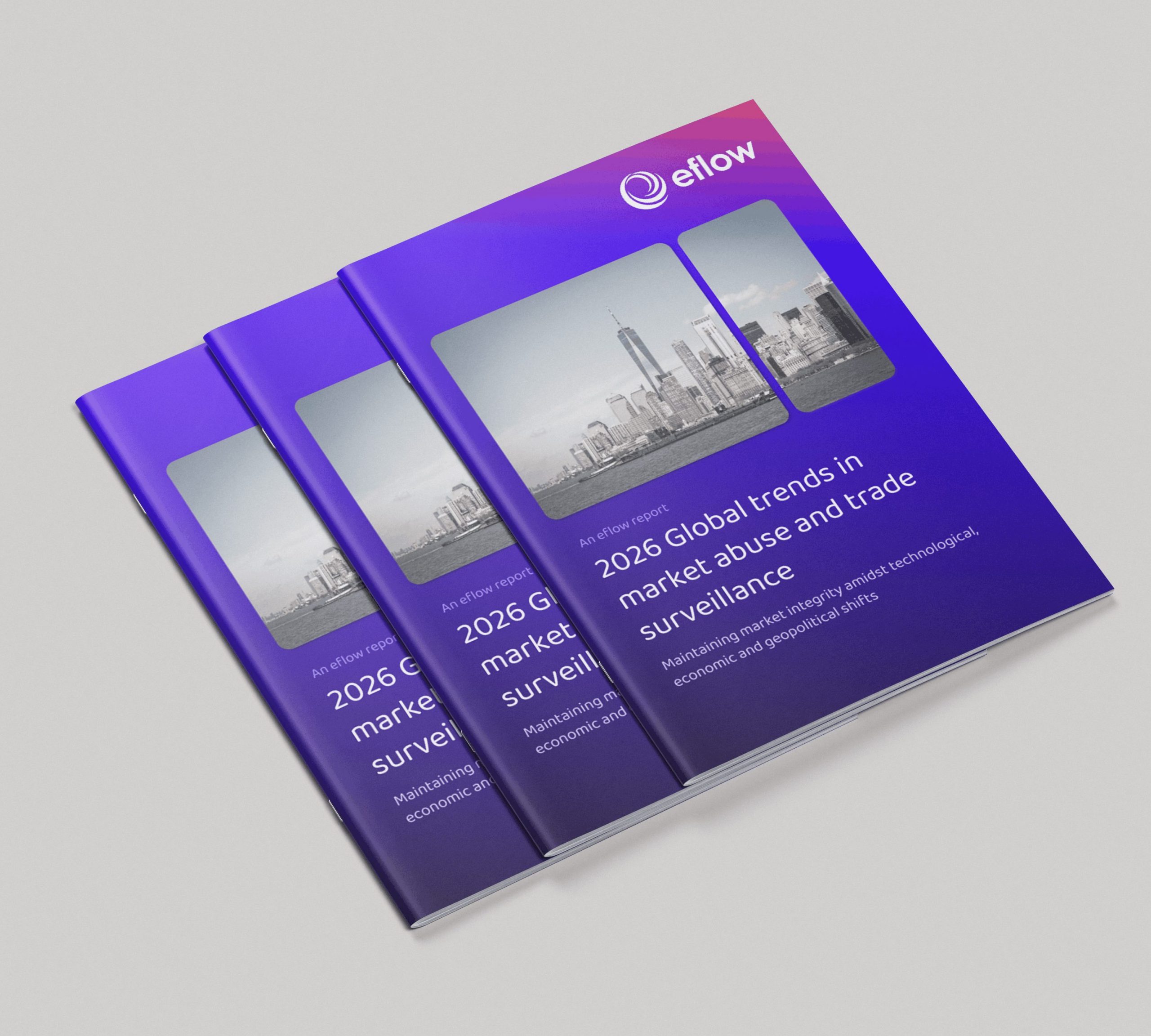
A new global report from eflow has found that financial institutions are increasingly concerned about the compliance risks associated with the rapid adoption of AI, with nearly seven in ten regulatory leaders warning that the technology could create new challenges over the next year.
The findings come from eflow’s Global Trends in Market Abuse and Trade Surveillance Report 2026, which surveyed 300 senior regulatory compliance decision makers across Europe, North America and the APAC region.
The research provides a snapshot of the shifting pressures facing compliance teams as emerging technologies, regulatory uncertainty and geopolitical tensions reshape the operating environment for financial services firms.
According to the study, 69% of respondents believe the accelerating use of AI will lead to compliance issues within the next 12 months. The research suggests that while financial institutions are increasingly embracing AI across trading and operational processes, many remain cautious about how the technology could alter the landscape for market abuse detection and trade surveillance.
Alongside the rise of AI, regulatory leaders continue to highlight broader external pressures. Around 65% of firms cited regulatory uncertainty as a key compliance risk, while 54% said geopolitical instability is intensifying the challenges faced by compliance and surveillance teams. These overlapping pressures are forcing organisations to reassess their approach to risk management and regulatory readiness.
Despite growing concern about AI-related risks, the report indicates that most firms are still in the early stages of adopting the technology within surveillance operations. Only 16% of firms have fully implemented AI within their trade surveillance frameworks. Meanwhile, 31% of organisations are currently deploying AI in selected areas, and 24% plan to introduce AI-driven capabilities within the next 12 to 24 months.
However, the research also highlights a significant readiness gap. Nearly three in ten firms, representing 29% of respondents, said they either do not have a formal strategy for incorporating AI into trade surveillance or have no plans to deploy the technology at all.
Regulatory complexity continues to play a central role in shaping compliance priorities. Nearly two thirds of firms, representing 65%, identified regulatory uncertainty as a major risk, with concern particularly high in the United States where 75% of firms raised the issue. By comparison, 63% of UK firms highlighted regulatory uncertainty as a key challenge.
The report also reveals notable regional differences in compliance priorities. U.S. firms were more likely to flag both regulatory uncertainty and developments in crypto markets as drivers of future compliance risk. Operational challenges also vary geographically, with 58% of U.S. firms highlighting the difficulty of integrating trade surveillance with electronic communications monitoring, compared with 40% of firms globally.
eflow co-founder and CEO Ben Parker said the findings illustrate how rapidly changing technology and market conditions are reshaping compliance strategies across the financial sector.
eflow co-founder and CEO Ben Parker said, “AI is now reshaping both how markets operate and how misconduct can emerge. Our 2026 findings show that firms clearly recognise this shift, but many are still building the foundations needed to deploy AI responsibly and effectively within their trade surveillance operations.
“At the same time, regulatory uncertainty and ongoing market volatility continue to place compliance teams under sustained pressure. Stronger collaboration between firms and regulators will be essential to ensure innovation can progress without undermining market integrity.”
As regulators introduce new expectations around surveillance and risk oversight, the research suggests that many financial institutions are seeking closer engagement with supervisory bodies. Half of respondents, representing 50% of firms, said stronger collaboration between regulators and compliance teams would be the most effective way to balance market integrity with innovation and growth.
In addition, 47% of firms said they would like greater transparency around regulatory expectations and enforcement actions, suggesting that clearer guidance could help institutions adapt more effectively to evolving compliance requirements.
The report highlights how trade surveillance and market abuse detection are entering a new phase, where firms must navigate both technological transformation and increasingly complex regulatory landscapes. As AI adoption accelerates across financial markets, compliance teams are likely to face growing expectations from regulators to demonstrate robust governance, oversight and transparency in how these technologies are deployed.
Keep up with all the latest RegTech news here
Copyright © 2026 RegTech Analyst
Copyright © 2026 RegTech Analyst