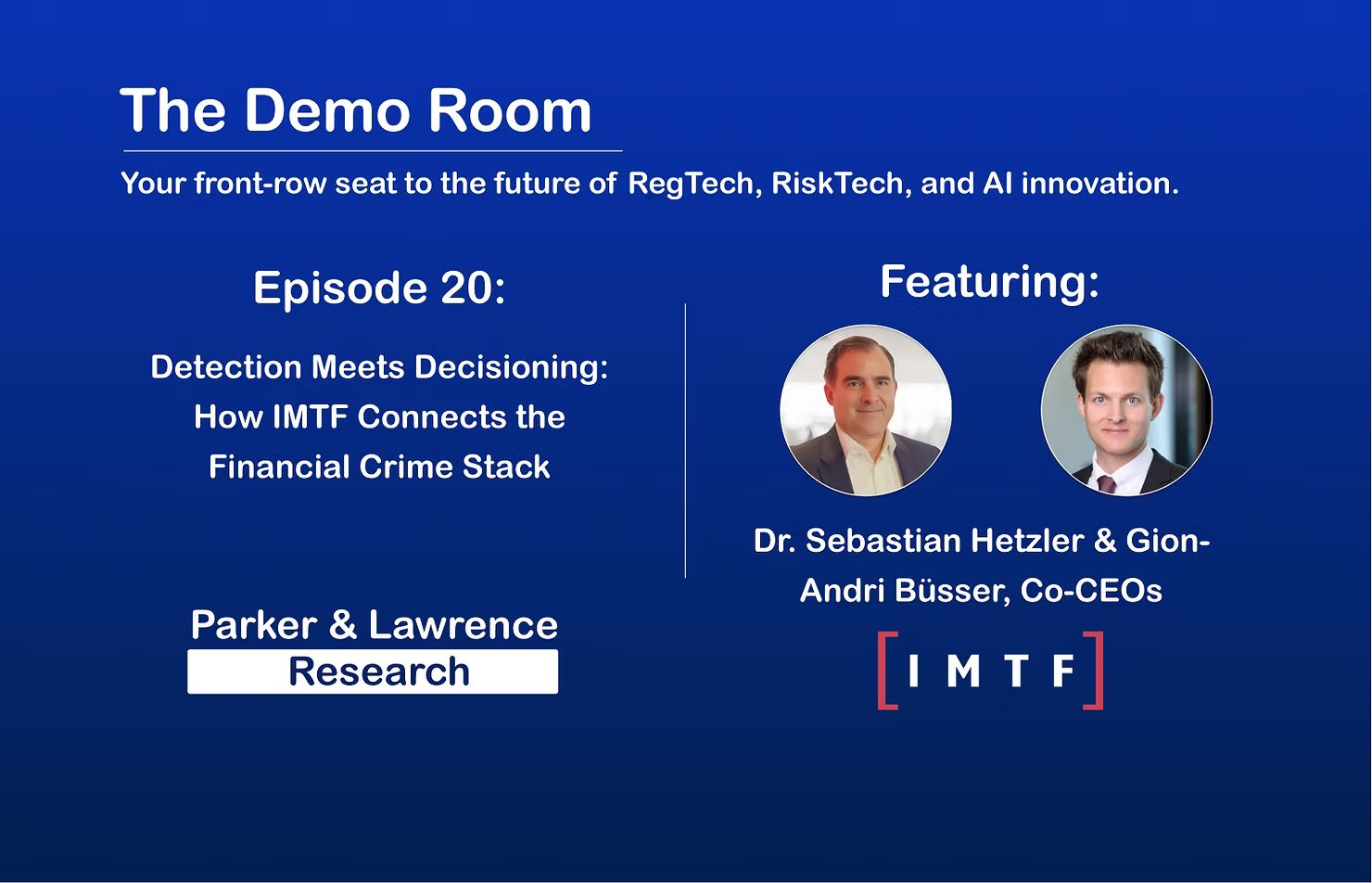
For many years financial institutions have invested heavily in tools that detect suspicious activity. However, detection is only one part of the equation, and another real challenge lies in turning alerts, data and risk signals into fast, consistent decisions. The Global State of RegTech 2026 report – authored by RegTech Analyst and Parker & Lawrence Research – took the time to examine the shifting trends in financial crime stacks and how companies must respond.
As part of the research for the report, Parker & Lawrence Research interviewed market leaders in the space on how they are transforming financial crime stacks for the challenges of today and what comes next.
On this occasion, the firm spoke with Gion-Andri Büsser and Sebastian Hetzler, co-CEO’s of IMTF, which is a provider of Siron®One, a financial crime compliance platform covering transaction monitoring, sanctions screening, KYC/CDD, fraud and case management. Parker & Lawrence Research detailed that IMTF’s strength is its balance of depth and stability.
This interview was part of the wider Global State of RegTech report conducted by RegTech Analyst and Parker Lawrence Research. To download the full report, click here.
Transaction monitoring has long been treated as a box to tick. Alerts fire, analysts investigate, cases are escalated. That model persists at many institutions, but the environment in which it operates has changed fundamentally, and the gaps are beginning to show.
Real-time payments leave little room for intervention. Cross-border flows generate increasingly complex data trails. Criminal typologies have grown more networked, with fraud, sanctions, know-your-customer (KYC) and anti-money laundering (AML) signals converging in ways that siloed controls were never designed to handle. Regulators, meanwhile, are demanding more than compliance in name, they want firms to demonstrate that monitoring is effective, governed and capable of explanation.
The Global State of RegTech 2026 captures this shift, describing a market moving toward entity-centric, cross-domain financial crime decisioning. Rather than treating each alert as an isolated incident, institutions are being asked to develop a unified view of customer risk, one that draws together transaction behaviour, lifecycle data and external intelligence. The unit of analysis is no longer the alert. It is the customer, or indeed the network they sit within.
Swiss RegTech firm IMTF has built its Siron®One platform around precisely this connected model.
IMTF VP of product management Youness Bouchabchoub said, “We have the two layers in our platform, the detection layer and the decision layer.”
The problem firms are trying to solve
Despite growing regulatory pressure, many financial institutions still operate fragmented financial crime stacks. Transaction monitoring, sanctions screening, KYC, fraud detection and case management frequently sit in separate tools, each with its own data model, workflows and reporting lines. The result is that the same customer may be assessed very differently depending on which domain flags them first.
The operational consequences are significant. Analysts wade through high volumes of false positives. Investigations are repetitive and context-poor. Governance teams struggle to tune and test models with any consistency. And senior leaders face an almost impossible task trying to understand risk exposure across products, customers and jurisdictions from disconnected dashboards.
Legacy infrastructure compounds the problem. Large institutions may be deeply embedded in in-house systems that are expensive to maintain and slow to adapt. Mid-tier firms face a different challenge, the need for faster deployment and lower complexity, without sacrificing regulatory confidence.
The core issue is not simply that alerts are generated. It is whether those alerts can be connected to broader decisioning logic, whether prioritisation can be justified, and whether the control environment can be continuously improved.
IMTF’s Siron®One: a unified approach
Siron®One brings together customer onboarding and KYC, transaction monitoring, sanctions screening, fraud detection, alert and case management, and AI-powered decision support into a single compliance environment.
At its foundation is a unified data layer. Siron®One consolidates data from onboarding, KYC, transactions and third-party intelligence sources into a consistent structure, connecting with core banking and payment systems through open, API-based architecture. This creates a more complete view of the customer, with onboarding and KYC data feeding directly into monitoring scenarios to enable more contextual, risk-based detection throughout the customer lifecycle.
Monitoring logic within the platform is highly configurable. Users can set different thresholds and risk parameters for different customer categories — without writing code. A threshold appropriate for a private individual is unlikely to be suitable for a corporate client or a construction business, and Siron®One allows firms to reflect that in their detection logic.
The platform also supports forward and backward simulation, enabling institutions to test scenario changes against production data before deploying them. This is a meaningful governance capability. Changes to monitoring logic can have material impacts on alert volumes, analyst workload and risk coverage. Simulation gives compliance teams greater confidence before any change goes live, and supports ongoing model governance and validation.
In terms of decisioning, Siron®One’s case management layer allows analysts to review transaction monitoring alerts alongside related screening, KYC, fraud and customer-risk signals in a single 360-degree view. Rather than assessing each alert in isolation, the platform supports risk assessment at the level of the customer or entity — cutting across traditional compliance silos. Workflow tools handle assignment, escalation, documentation and suspicious activity reporting, while management dashboards provide visibility across alert volumes, investigation outcomes and risk trends.
On the AI side, IMTF has taken a deliberately hybrid approach. Rules remain important for known typologies and regulatory transparency. AI adds prioritisation, anomaly detection and contextual support. Siron®One includes an alert predictive score, which compares incoming alerts against historically confirmed ones to support prioritisation, and an entity deviation score, which uses clustering to flag customers behaving differently from their peer group. AI is also deployed in name screening and entity resolution, with chatbot-style analyst support currently in development. Human review remains central throughout.
Read the original post from Parker & Lawrence Research here.
Copyright © 2026 RegTech Analyst
Copyright © 2026 RegTech Analyst