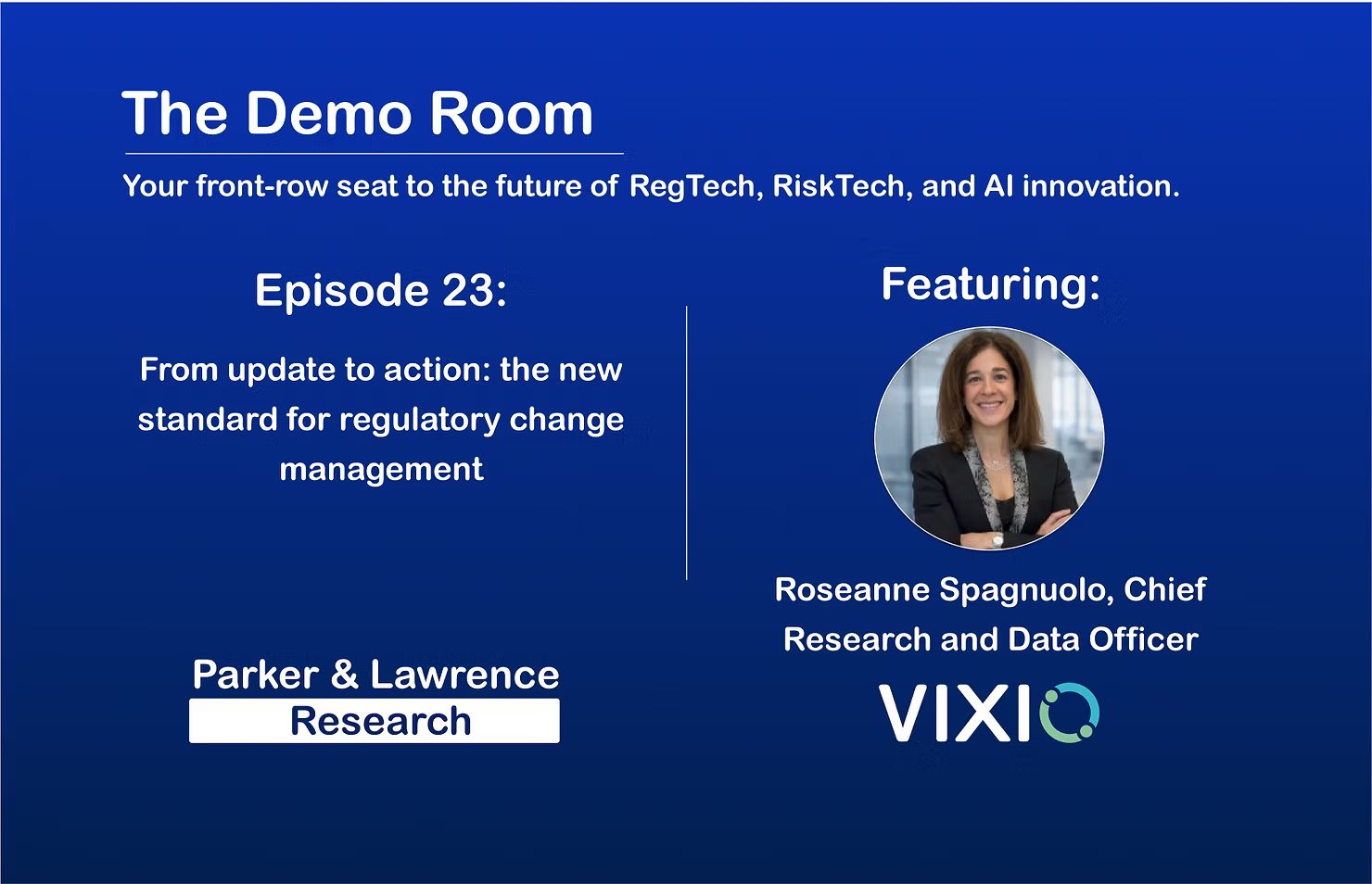
Regulatory change has become a constant challenge for financial institutions, with firms facing an ever-growing volume of new rules, updates and supervisory expectations across multiple jurisdictions. As manual processes struggle to keep pace, technology is becoming essential to helping organisations identify, assess and implement regulatory changes efficiently. The Global State of RegTech 2026 report – authored by RegTech Analyst and Parker & Lawrence Research – delved into regulatory change management and why it is becoming ever more vital.
As part of the research for the report, Parker & Lawrence Research interviewed market leaders in the space to discuss the importance of regulatory change management in 2026.
On this occasion, the firm spoke with Roseanne Spagnuolo, Chief Research and Data Officer, Vixio, a regulatory change management platform for firms operating across financial services, payments, digital assets, gambling and gaming.
This interview was part of the wider Global State of RegTech report conducted by RegTech Analyst and Parker Lawrence Research. To download the full report, click here.
Regulatory change management has long been a persistent headache for compliance teams, but the nature of the problem has shifted. Access to information is no longer the constraint; regulatory updates are publicly available and increasingly digital. The real difficulty lies in determining which updates are material to a firm, what they require in practice, who owns the response, and how the organisation evidences that it acted.
That challenge is only deepening. Firms now operate across more jurisdictions, products and licence types, each carrying its own regulatory calendar and expectations. Simultaneously, regulators are producing more output than ever, spanning new rules, consultations, thematic reviews and enforcement signals.
According to The Global State of RegTech 2026, Compliance Management remains a domain with relatively immature technology adoption. The majority of institutions still rely on spreadsheets and siloed technology stacks to handle horizon scanning, obligation mapping, compliance gap analysis and remediation task management.
Yet compliance teams sit in a uniquely valuable position, at the intersection of regulatory intelligence and business operations, with firm-wide visibility that few other functions enjoy. This creates a genuine opportunity to shift from enforcer to informer, becoming the function that tells the business what is coming, what it means and what to do next. Seizing that opportunity, however, demands infrastructure capable of matching the volume and complexity of the modern regulatory environment.
Vixio chief research and data officer Roseanne Spagnuolo said, “Regulatory change management is no longer just a line item in the compliance budget. It’s critical infrastructure.”
Knowing an update has been published is the easy part. The harder questions follow. Is it relevant? Is it actionable? Which products, licences, jurisdictions and policies does it touch? Who owns the response, what decision was taken, and can the firm prove the right people reviewed it at the right time? Regulatory text is rarely self-executing, and the distance between what a regulator has said and what it means for a specific business model can be considerable.
For multi-jurisdictional firms, the problem sharpens. The same theme can unfold differently across markets, with payments, digital assets, consumer protection, AML, fraud, operational resilience and financial promotions all evolving at different speeds. Some regimes are highly prescriptive, while others lean on principles.
Manual processes buckle at this scale. Excel trackers, local inboxes and shared folders may suffice for a small firm with a narrow regulatory perimeter, but they turn fragile as an organisation expands into new markets, acquires businesses or launches new products.
Boards are asking sharper questions too. They want foresight rather than status updates, wanting to know what is coming, whether the firm is prepared and whether existing controls will hold.
Vixio chief research and data officer Roseanne Spagnuolo said, “Customers want to know where the puck is going, not where it is.”
Vixio’s regulatory change management platform combines regulatory intelligence with execution, helping firms monitor change, interpret relevance, route work, manage obligations and build an evidence trail from source material through to business action.
On horizon scanning, the platform monitors over 8,000 regulatory authorities across roughly 200 jurisdictions. Users can filter by jurisdiction, authority, document type and area of interest, building watchlists that mirror the firm’s actual regulatory perimeter. Updates are classified as actionable, indicative or informative, a simple distinction that helps teams separate items requiring immediate action from those needing monitoring or awareness only. Regulatory deadlines are surfaced to flag time sensitivity, and alerts can run daily, weekly or monthly, or feed into the wider workflow. The value lies in cutting noise without sacrificing coverage.
Analyst-led interpretation remains central to the product, reflecting Vixio’s research heritage. The platform provides analyst insights, jurisdictional analysis and forward-looking commentary, explaining what a development means, how it may affect different business models and what firms should consider next. This layer proves especially valuable where regulation is unclear, principles-based or still developing, with consultations, speeches, enforcement actions and political signals all potentially significant before a final rule lands. The Ask the Analyst capability lets compliance teams seek clarification directly from specialists who track the relevant regulatory environment.
Structured intelligence comes through country reports, offering a jurisdictional view of frameworks, recent developments, exemptions, authorities and source materials, and requirements reports, which give an activity-specific view of what applies when a firm offers a particular service in a particular market. A report builder turns this intelligence into usable internal outputs.
The obligations library creates a structured record of what a firm must follow. Users can extract obligation text from source documents, categorise it, assign risk, determine applicability and add it to a central library. The platform is pushing further into obligation-to-policy linkage, connecting obligations to policies, procedures and controls. Once those links exist, the system can flag which policies or controls may need updating when source material changes, shifting the workflow from manual discovery to prediction.
A workspace lets users triage updates, assign work, set priorities and track progress, supporting collaboration across compliance, legal, product, operations and other teams, recognising that regulatory change rarely belongs to one function.
Finally, Vixio pairs AI with human validation. Its SCANS technology uses supervised machine learning to capture, collate, aggregate, normalise and surface relevant updates, while VIQ, its AI assistant, lets users query the regulatory dataset and receive summarised responses with source references. Human expertise remains essential for interpretation, judgement and confidence.
Vixio chief research and data officer Roseanne Spagnuolo said, “The combination of human judgment and machine precision is often underestimated.”
Read the original post from Parker & Lawrence Research here.
Copyright © 2026 RegTech Analyst
Copyright © 2026 RegTech Analyst