

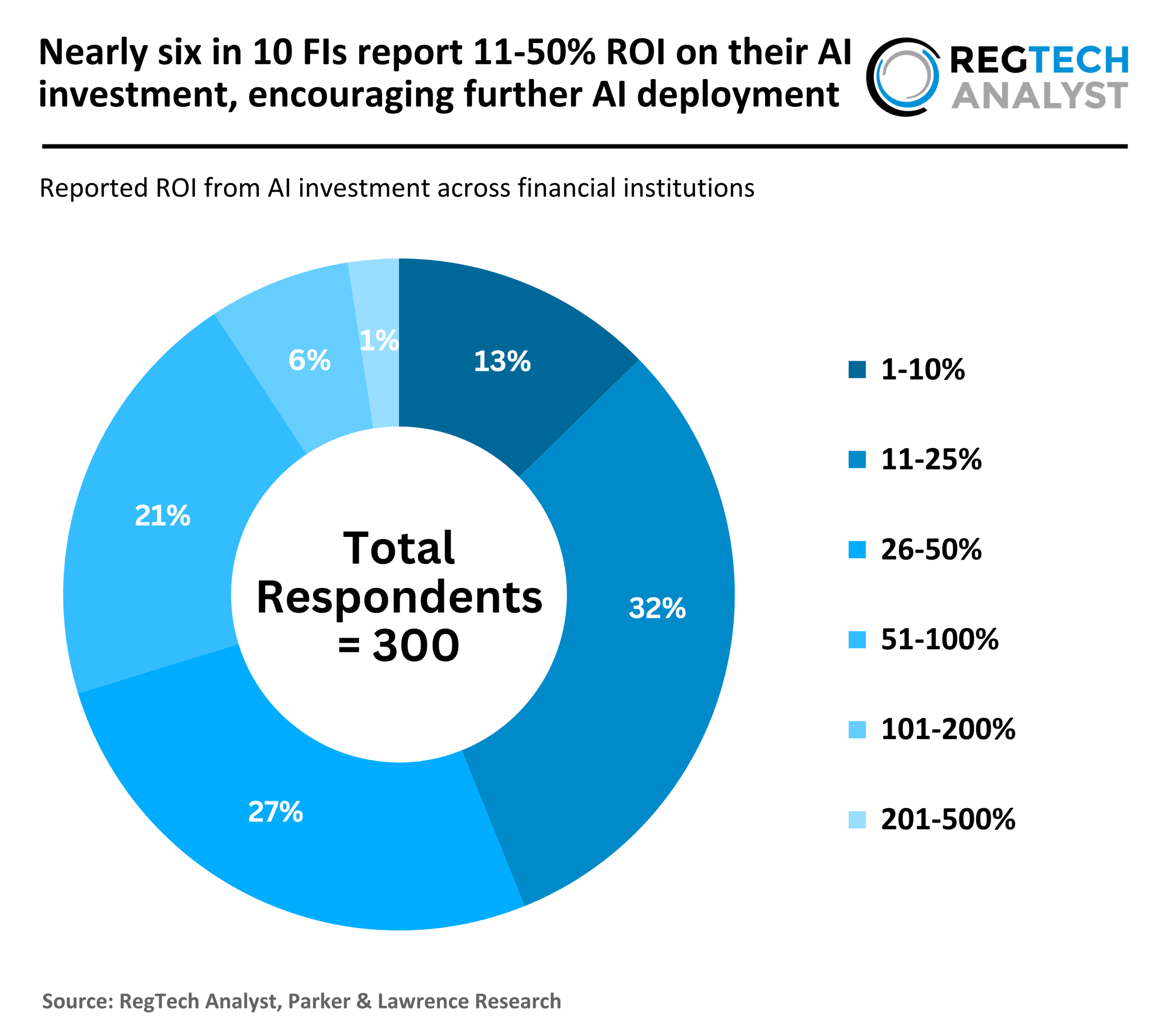
Key views on reported ROI from AI investment across financial institutions:
- AI in Risk and Compliance 2026 surveyed 300 senior risk and compliance professionals across six markets on their realised return on AI investment
- Nearly six in 10 FIs report returns between 11% and 50%, with the 11% to 25% band the most common at 32%
- Every FI respondent reports a positive return, yet most remain in a modest range, pointing to significant room for deeper AI deployment
AI in Risk and Compliance 2026 surveyed 300 senior risk and compliance professionals across six markets on their realised return on AI investment
The findings come from AI in Risk and Compliance 2026 report, produced by RegTech Analyst and Parker & Lawrence Research.
The study draws on 300 senior risk and compliance professionals across six markets, spanning financial institutions (56%) and FinTechs (44%).
Respondents represent a broad cross-section of seniority, from compliance managers through to chief risk officers and heads of FinCrime, and cover retail banking, payments, insurance, investment banking and asset management.
The chart captures the realised return on AI investment as reported by financial institutions specifically, presenting self-reported estimates across six ROI bands rather than audited financial returns.
Nearly six in 10 FIs report returns between 11% and 50%, with the 11% to 25% band the most common at 32%
The results point to a market where positive returns are now the norm, though the distribution tells a more nuanced story than the headline figure suggests.
The 11% to 25% band is the most commonly cited at 32%, and together with the 26% to 50% band at 27%, these two middle ranges account for nearly six in ten respondents.
That clustering is significant: it suggests the majority of firms have moved past the zero-return phase but have not yet reached the kind of returns that would signal AI is reshaping their operations at scale.
The 21% reporting returns of 51% to 100% represent what the report terms ROI leaders, and the data shows these firms are not simply spending more – they differ most from lower-return peers in the outcomes they are targeting.
ROI leaders are considerably more likely to report faster onboarding and approvals, where the gap between leaders and the lowest-return group is nearly 16 percentage points, and faster product launches, where the gap is similar.
At the lower end, 13% report returns of just 1% to 10%, while 6% and 1% report returns in the 101% to 200% and 201% to 500% bands respectively.
The skew toward the middle of the distribution, rather than toward either extreme, is the detail that matters most.
Every FI respondent reports a positive return, yet most remain in a modest range, pointing to significant room for deeper AI deployment
What the data signals is a meaningful shift in the narrative around AI returns in financial services.
A year ago, the dominant concern was whether AI investment was delivering anything at all.
The current picture is more encouraging: every respondent reports a positive realised return, and more than a quarter now sit above the 50% mark.
That said, the results deserve careful interpretation.
Nearly a third of institutions still struggle to measure ROI reliably, and these figures are estimates rather than verified outcomes.
The concentration of responses in the 11% to 50% range suggests that while AI is delivering, most firms have not yet unlocked the step-change returns that early adoption narratives promised.
The firms reporting returns above 50% are likely those that have moved beyond isolated use cases and begun deploying AI more systematically across their risk and compliance functions, which points to where the broader market needs to focus next.
Keep up with all the latest RegTech news here
Copyright © 2026 RegTech Analyst
Copyright © 2026 RegTech Analyst


