Key RegTech implementation stats in financial services:
- The Global State of RegTech report, surveyed 300 senior risk and compliance decision-makers and 100 vendors to assess the trajectory of RegTech adoption across financial services
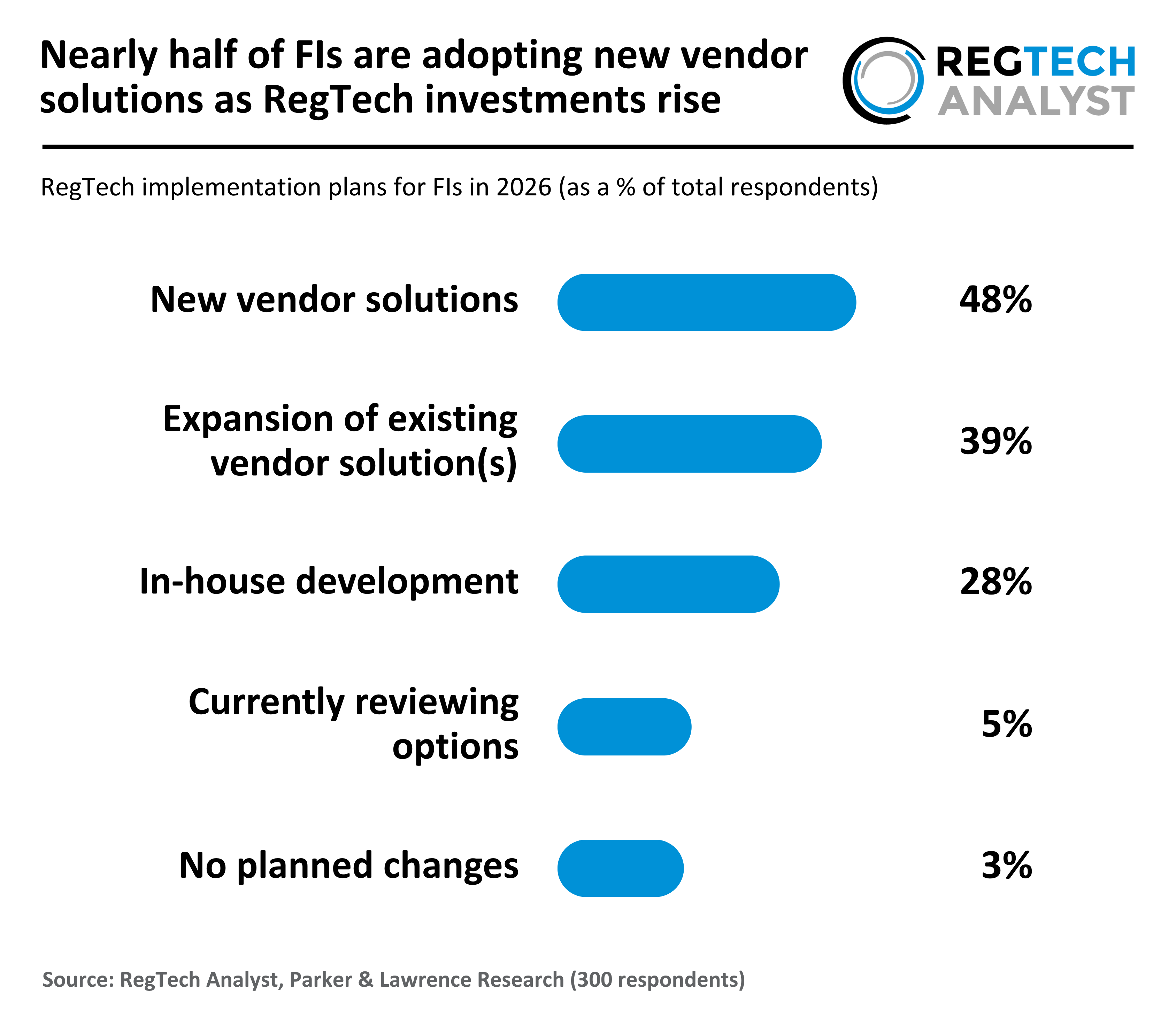
- Nearly half of respondents (48%) plan to adopt new vendor solutions this year, with over nine in ten institutions either investing in or actively reviewing RegTech infrastructure
- The data signals a market in execution mode, with vendor relationships deepening and a growing minority building in-house as AI reduces the cost of internal development
The Global State of RegTech report, surveyed 300 senior risk and compliance decision-makers and 100 vendors to assess the trajectory of RegTech adoption across financial services
The Global State of RegTech, produced by RegTech Analyst and Parker & Lawrence Research, draws on a substantial body of primary and secondary research to map the current RegTech landscape across financial services.
The study combines global surveys of 300 senior risk and compliance decision-makers at financial institutions globally and 100 RegTech vendors with qualitative interviews conducted alongside regulators, regulated entities and market experts.
It also incorporates deep-dive analysis across six risk and compliance domains, as well as bottom-up market sizing built from 2026 spend data, population modelling, 2025 vendor funding figures and a review of 63 published market estimates.
Among the questions put to respondents was whether they expected to implement new or expanded RegTech solutions during the year.
Nearly half of respondents (48%) plan to adopt new vendor solutions this year, with over nine in ten institutions either investing in or actively reviewing RegTech infrastructure
The results point to a sector in an active phase of investment.
Nearly half of respondents (48%) said they planned to bring in new vendor solutions, making it the most commonly cited path to RegTech expansion.
A further 39% indicated they would extend or scale existing vendor relationships, while 28% said they expected to pursue in-house development.
Only a small minority were standing still: 5% said they were not planning new implementations but were currently reviewing their options, and just 3% reported no planned changes at all.
Multiple responses were permitted, meaning respondents could indicate more than one route to adoption simultaneously.
The data signals a market in execution mode, with vendor relationships deepening and a growing minority building in-house as AI reduces the cost of internal development
Taken together, the data suggests that well over nine in ten institutions are either actively investing in RegTech or at least keeping their options under review – a striking indicator of how central technology has become to compliance strategy.
The strong showing for new vendor solutions reflects the continued difficulty of building production-grade capability in-house, even as AI is lowering the cost of internal prototyping and prompting more engineering-capable institutions to develop their own tools.
The parallel appetite for expanding existing vendor relationships points to a market that is maturing rather than constantly churning: institutions increasingly want to deepen what they already have rather than start from scratch.
The relatively modest figure for in-house development, while still significant at more than a quarter of respondents, underlines that most firms continue to rely on the specialist governance, delivery and ongoing support that established vendors provide.
Keep up with all the latest RegTech news here
Copyright © 2026 RegTech Analyst
Copyright © 2026 RegTech Analyst