Key views on change in the barriers to AI deployment across FIs:
- AI in Risk and Compliance 2026 surveyed 300 senior professionals across six markets, while the 2025 edition is based on 224 respondents
- Data quality leads at 52%, up from 37%, as expertise and regulatory uncertainty also rise
- Barriers have shifted from build costs and staff resistance to data, skills and regulation as firms move to production
AI in Risk and Compliance 2026 surveyed 300 senior professionals across six markets, with 2025 data from 224 respondents
The findings come from AI in Risk and Compliance 2026 report, produced by RegTech Analyst and Parker & Lawrence Research.
The 2026 study draws on 300 senior risk and compliance professionals across six markets, led by the US (33%) and the UK (20%), with France and the UAE (13% each) and Singapore and Australia (10% each) making up the rest.
Respondents are split between financial institutions (56%) and FinTechs (44%), and cover retail banking, payments, insurance, investment banking and asset management.
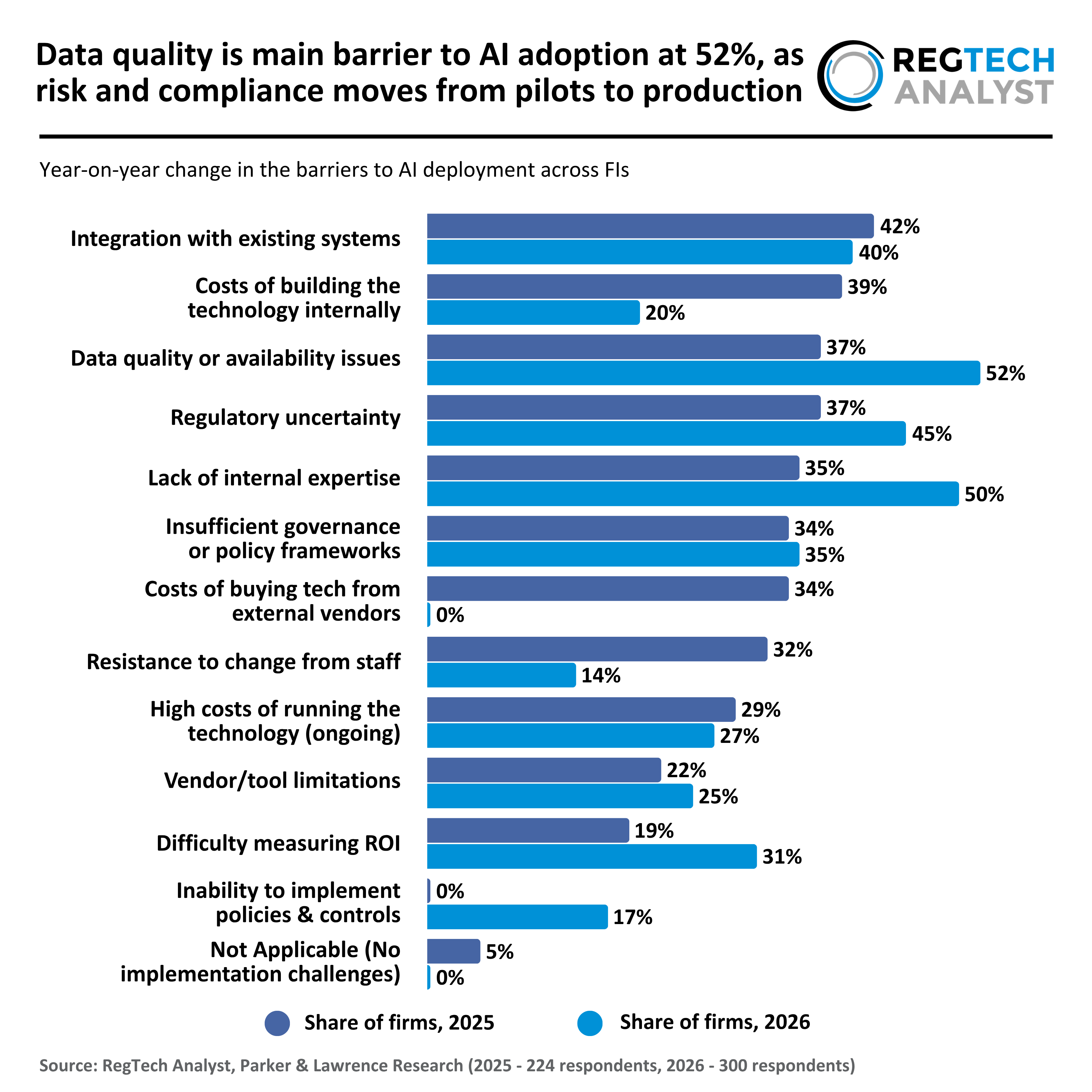
The 2025 comparison is drawn from a smaller sample of 224 respondents. The chart tracks the barriers firms face in deploying AI, and how they have shifted over the past year.
Data quality leads at 52%, up from 37%, as expertise and regulatory uncertainty also rise
The shift in barriers tells a story about where firms are in their AI journey.
Multiple responses were permitted.
Data quality or availability issues now lead at 52%, up 15 percentage points from 37% in 2025.
Lack of internal expertise follows at 50%, up from 35%, and regulatory uncertainty at 45%, up from 37%.
These are the constraints that appear when pilots move into production, where firms need dependable inputs, people who understand both AI and regulation, and a defensible reading of what supervisors expect.
Integration with existing systems is the clearest example of a barrier being overtaken rather than solved.
It was the most cited challenge in 2025 at 42% and has barely moved at 40%, yet it now ranks fourth.
The fall in concern about build costs, from 39% to 20%, is consistent with AI lowering the cost of prototyping, while resistance to change from staff has more than halved, from 32% to 14%, suggesting the cultural case for AI has largely been won.
Difficulty measuring ROI has risen from 19% to 31%.
Doubt over whether AI creates value has receded, but attributing the benefit across avoided losses, faster decisions and staff capacity is proving harder.
The report also finds that ROI leaders are not operating in easier environments.
They are less constrained by integration and regulatory uncertainty, but more likely to face staff resistance, vendor limitations and the practical challenge of turning policy into operational controls, a barrier cited by 17% of firms for the first time this year.
Barriers have shifted from build costs and staff resistance to data, skills and regulation as firms move to production
The pattern suggests that firms are now facing the barriers that come with production, rather than those that come with experimentation.
Falling concern about build costs and staff resistance points to a market that has accepted AI as worth pursuing.
What stands in the way now is the foundations.
Firms need reliable data, people who understand both AI and regulation, and a clear view of what supervisors expect.
The rise in difficulty measuring ROI fits this picture.
Doubt over whether AI creates value has faded, but attributing the benefit across avoided losses, faster decisions and staff capacity is harder than it looks.
The two samples differ in size, so year-on-year movements are best read as indicative rather than exact.
For institutions, the priority is to invest in data quality and specialist skills before scaling further, and to build the measurement frameworks that let them evidence returns.
Keep up with all the latest RegTech news here
Copyright © 2026 RegTech Analyst
Copyright © 2026 RegTech Analyst