Key views on Impact of automation and AI across asset management functions:
- AI in Risk and Compliance 2026 surveyed 300 senior risk and compliance professionals across six markets and 100 vendors on how AI model types influence decisions
- LLMs record the highest material influence at 21%, while AI agents lead on preparatory use at 49%
- The data shows firms calibrating trust by model type, keeping flexible AI in a supporting role while established techniques carry the most decision weight
AI in Risk and Compliance 2026 surveyed 300 senior risk and compliance professionals across six markets and 100 vendors on how AI model types influence decisions
The findings come from AI in Risk and Compliance 2026, produced by RegTech Analyst and Parker & Lawrence Research.
The study draws on 300 senior risk and compliance professionals across six markets, spanning financial institutions (56%) and FinTechs (44%), and a parallel survey of 100 risk and compliance technology vendors.
Respondents represent a broad cross-section of seniority, from compliance managers through to chief risk officers and heads of FinCrime, and cover retail banking, payments, insurance, investment banking and asset management.
The vendor base serves clients across Europe, the Americas, Asia-Pacific, the Middle East and Africa.
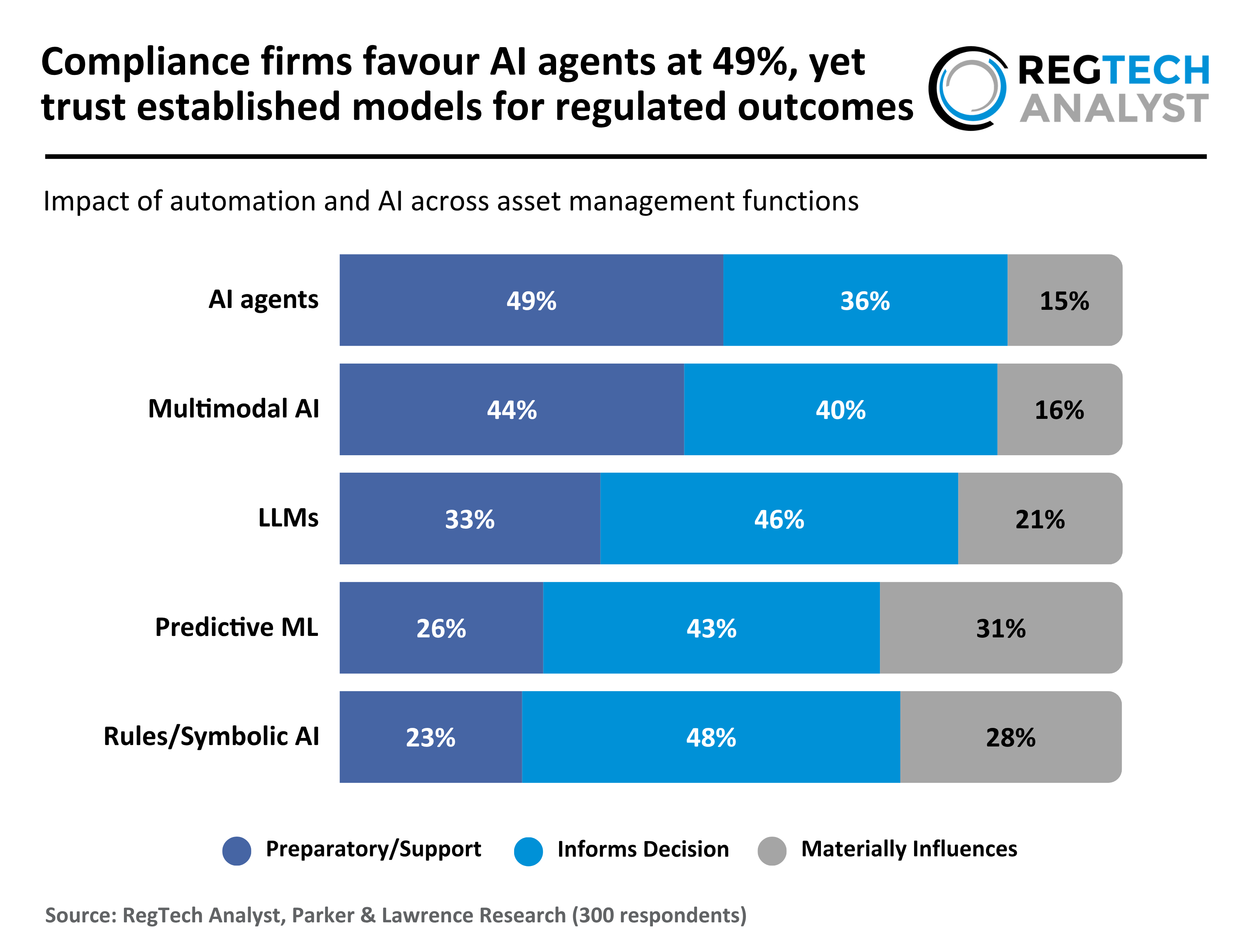
The chart examines how different AI model types influence decisions in risk and compliance environments.
LLMs record the highest material influence at 21%, while AI agents lead on preparatory use at 49%
The results reveal a clear hierarchy of trust, with the oldest and most bounded model types carrying the greatest decision-making weight.
AI agents record the highest preparatory and support usage at 49%, but also a material influence figure of 15%, suggesting that while they are most commonly used in a supporting capacity, a meaningful share of firms are already allowing them to shape outcomes directly.
Multimodal AI follows a similar pattern, with 44% preparatory use and 16% material influence.
LLMs sit at 33% preparatory and 21% material influence, the highest material influence figure in the dataset, a finding that may reflect the maturity of LLM deployment in document-heavy compliance workflows where their ability to interpret and communicate complex information is particularly valuable.
Predictive ML records 26% preparatory use, 43% informing decisions and 31% material influence, pointing to a model type that is deeply embedded in consequential work.
Rules and symbolic AI closes the list with the lowest preparatory figure at 23%, 48% informing decisions and 28% material influence, the second highest across the chart, confirming that deterministic logic remains a core and trusted component of regulated decision-making.
The data shows firms calibrating trust by model type, keeping flexible AI in a supporting role while established techniques carry the most decision weight
What the data reveals is not simply a ranking of AI model types by adoption, but a picture of how firms are calibrating trust according to the nature of the technology itself.
The more flexible and general-purpose the model, the more firms tend to keep it at arm’s length from consequential decisions, using it to retrieve information, interpret evidence or prepare outputs rather than determine outcomes directly.
The relative comfort with rules-based and predictive systems reflects their bounded, testable nature: firms know what these models will do and can verify it.
LLMs and agents, by contrast, operate across a wider range of inputs and tasks, which makes their behaviour harder to predict and their outputs harder to audit in a regulated context.
The 31% material influence figure for predictive ML and 28.3% for rules-based systems confirm that these established techniques have earned a level of institutional trust that newer approaches have not yet matched.
For firms navigating this landscape, the practical implication is that the path to deploying more capable AI in regulated decisions runs through governance, testability and control, not capability alone.
Keep up with all the latest RegTech news here
Copyright © 2026 RegTech Analyst
Copyright © 2026 RegTech Analyst