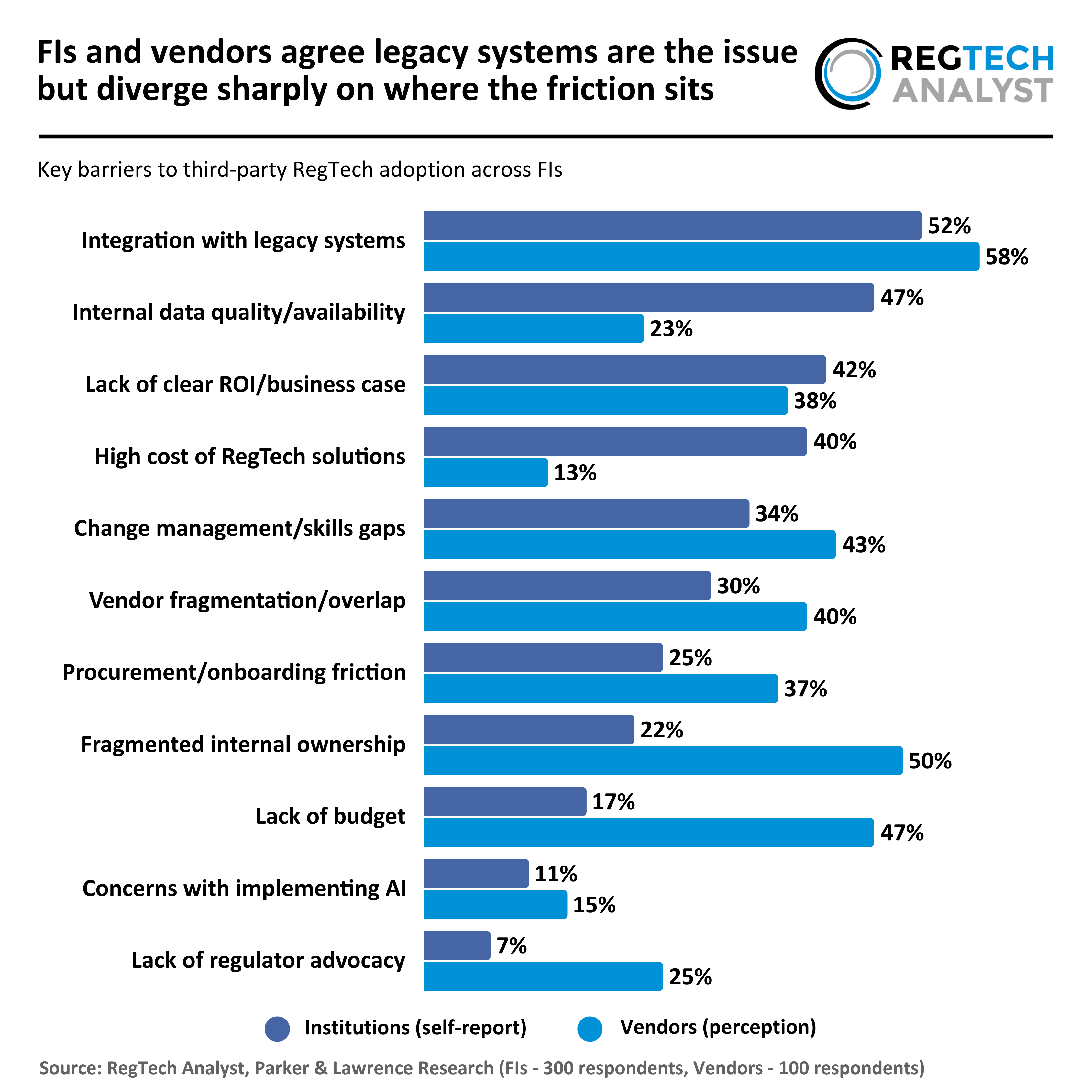
Key views on barriers to third-party RegTech adoption across FIs:
- The Global State of RegTech surveyed 300 FI decision-makers and 100 vendors on the leading barriers to third-party RegTech adoption
- Integration with legacy systems tops the list for both groups at 58% among vendors, while fragmented ownership shows the widest split, at 22% vs 50%
- Vendors and institutions appear to be diagnosing different stages of the same adoption problem, each shaped by their own vantage point
The Global State of RegTech surveyed 300 FI decision-makers and 100 vendors on the leading barriers to third-party RegTech adoption
The Global State of RegTech was produced by RegTech Analyst and Parker & Lawrence Research.
It draws on global surveys of 300 senior risk and compliance decision-makers at financial institutions and 100 RegTech vendors, supplemented by qualitative interviews with regulators, regulated entities and market experts.
The study incorporates deep-dive analysis across six risk and compliance domains and bottom-up market sizing built from 2026 spend data, population modelling and a review of 63 published market estimates.
Among the questions put to both groups was what they regard as the most significant barriers to adopting third-party RegTech.
Integration with legacy systems tops the list for both groups at 58% among vendors, while fragmented ownership shows the widest split, at 22% vs 50%
Multiple responses were permitted, and the results tell a story of broad agreement at the top giving way to sharp disagreement further down the list.
Integration with legacy systems is the one barrier both groups rank as the most serious, cited by 52% of institutions and 58% of vendors, a reminder that ageing infrastructure remains the foundational obstacle no amount of vendor sophistication can fully overcome.
From there, the picture starts to fracture.
Institutions are considerably more troubled by their own internal data quality, naming it a top concern at 47% against just 23% of vendors, and by the cost of RegTech solutions, which 40% of institutions flag compared with only 13% of vendors.
Vendors, in turn, see a different set of problems entirely.
Fragmented internal ownership is cited by half of all vendors but only 22% of institutions, and lack of budget shows an almost identical split, at 47% versus 17%.
Change management and skills gaps, vendor fragmentation, and procurement friction all follow a similar pattern, with vendors consistently rating each issue higher than the institutions they work with.
The narrower concerns close the list: concerns with implementing AI sit at 15% for vendors and 11% for institutions, and lack of regulator advocacy at 25% and 7% respectively.
Vendors and institutions appear to be diagnosing different stages of the same adoption problem, each shaped by their own vantage point
The scale of disagreement raises a genuine question about whose view is closer to the truth, and the answer is probably that both sides are seeing something real, filtered through their own vantage point.
Vendors work across dozens of institutional clients and are well placed to notice patterns of fragmented ownership and underfunded projects that any single institution might not recognise as systemic in its own organisation.
Research into business software vendors has found a similar dynamic before: a BARC study of business intelligence providers found that vendors cited poor data quality as a client problem considerably more often than the clients themselves did, attributing the gap to vendors’ closer proximity to where projects actually break down.
Separate research from Bain and Google into B2B buying behaviour found that sellers regularly underestimate how many people inside a buying organisation hold real influence over a purchase, which would help explain why vendors see fragmented ownership as such a pervasive barrier.
At the same time, institutions have their own legitimate vantage point.
They are the ones living with the practical cost of legacy integration and the daily reality of messy internal data, concerns that vendors, who typically engage only once a contract is signed, may see only in part.
The most useful reading of this chart is not that one side is right and the other wrong, but that institutions and vendors are each diagnosing different stages of the same adoption problem, and closing the gap between those perspectives is likely to be just as important as solving any individual barrier.
Keep up with all the latest RegTech news here
Copyright © 2026 RegTech Analyst
Copyright © 2026 RegTech Analyst